

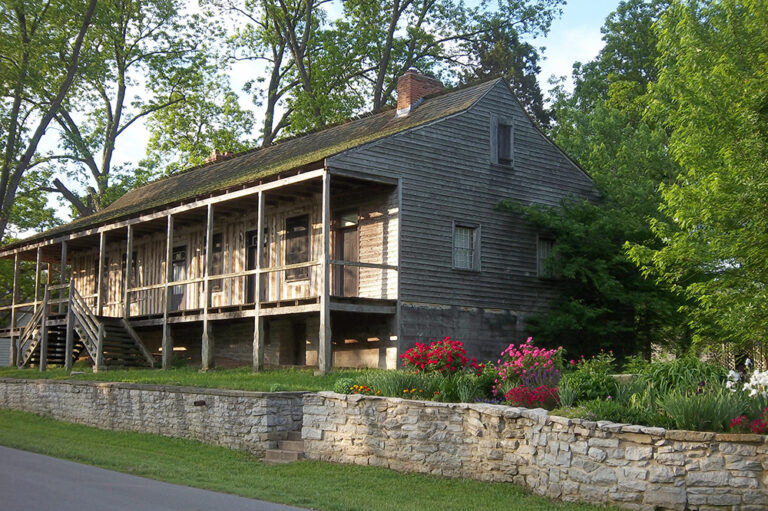
Green Tree Tavern – Missouri’s Oldest Standing Building and a Window Into Frontier History
Standing across from the famed locus of Jour de Fête in Sainte Geneviève, the Green Tree Tavern represents more than just historic architecture—it’s a living chronicle of American frontier life, cultural convergence, and the diverse lives that shaped the westward expansion. As the oldest verified building in Missouri, scientifically dated to 1790 through dendrochronology, this French colonial structure has served as family home, gathering place, inn, tobacco shop, and the meeting hall for the first Masonic Lodge west of the Mississippi River. Now part of Ste. Genevieve National Historical Park, Green Tree Tavern offers visitors a tangible connection to the complex, layered history of America’s heartland.
A Building That Tells Multiple Stories
What makes Green Tree Tavern exceptional isn’t just its age—it’s the remarkable diversity of human experiences that unfolded within its walls. Built by Nicolas Janis, a French Canadian immigrant from Kaskaskia, Illinois, the structure became home to his family and the fifteen people they enslaved. This uncomfortable truth sits at the foundation of Green Tree Tavern’s story, reminding us that Missouri’s early settlement depended on the forced labor of enslaved African Americans whose experiences were integral to the region’s development.
Among those enslaved at Green Tree Tavern was a woman named Clarisse and her children. After being willed through multiple generations of the Janis family as property, Clarisse finally received her freedom license in 1836. She then purchased her own home just down St. Marys Road—a house that still stands today as the Bequette-Ribault House and remained in her family for approximately 140 years. This proximity creates a powerful juxtaposition: the enslaver’s house and the formerly enslaved woman’s home standing on the same street, both preserved, both part of the historical record.
After Nicolas Janis died, his son François inherited the property and transformed it into an inn and tavern around 1803. One guest’s account from 1806 captures the hospitality François and his wife provided: “I was by no means disappointed; the landlord, a lively Frenchman, looked after my horses, and his wife made me a cup of coffee with as much perfection as ever I drank it at the Palais Royale, or at the foot of Pont Neuf.” This testimony reveals the sophistication that existed on what many might have considered the frontier—French culture and refinement thriving in a small Missouri river town.
The First Masonic Lodge West of the Mississippi
The Louisiana Purchase of 1803 brought dramatic change to Ste. Genevieve, suddenly transforming a French settlement under Spanish administration into American territory. With this political shift came an influx of American settlers, some of whom were Freemasons seeking to establish their fraternal organization in their new home.
In 1806, these local Freemasons petitioned the Grand Lodge of Pennsylvania to form the “Louisiana Lodge” in Sainte Geneviève. Their petition was approved on July 17, 1807, establishing Louisiana Lodge 109 as the first Masonic Lodge west of the Mississippi River. On November 14, 1807, the Lodge held its first meeting in François Janis’s tavern, making Green Tree Tavern the birthplace of Freemasonry in the trans-Mississippi West.
The Lodge’s tenure proved challenging. Financial difficulties plagued the organization as members struggled to collect and send dues to Pennsylvania. By 1824, Louisiana Lodge 109 lost its charter due to these financial problems. The dues were eventually settled, and by 1826, a new Masonic Lodge formed in Ste. Genevieve—but Green Tree Tavern had already secured its place in Masonic history.
Evidence of this Masonic connection survived in a remarkable way. During restoration work in the 1990s after the devastating 1993 flood damaged the building’s gallery posts, one of the largest collections of historical Ste. Genevieve graffiti was discovered carved into the original porch columns. Multiple Masonic symbols—the square and compass among them—were carved into these posts, along with the initials of François Ziegler, Henri Janis, and “N.J.” These posts have been preserved, offering physical proof of the Lodge’s presence and the people who gathered here.
From French to German: The Ziegler Era
In 1833, the Janis family sold Green Tree Tavern to Mathias and Barbara Ziegler, marking another cultural transition in the building’s story. The Zieglers were French-speaking Catholics who immigrated from an area of modern-day Germany that frequently shifted between French and German control. They arrived in Ste. Genevieve in the 1820s, part of a massive wave of German immigration inspired partly by Gottfried Duden’s writings that painted Missouri as an ideal place to settle.
Mathias Ziegler established a business partnership with Jean Baptiste Vallé—whose own historic house stands today as another component of Ste. Genevieve National Historical Park. Under their arrangement, Mathias manufactured tobacco while Jean Baptiste sold it in his general store. The Zieglers operated both the tavern and a tobacco shop from Green Tree Tavern, making it one of the earliest recorded tobacco shops in the region.
The Ziegler family raised their six children in the home while running their businesses. By the 1850s, they closed the commercial operations and converted the building back into a private residence. The Zieglers continued living in the house into the twentieth century, representing nearly a century of German-American stewardship of this French colonial structure.
Architectural Significance: Poteaux-Sur-Sole Construction
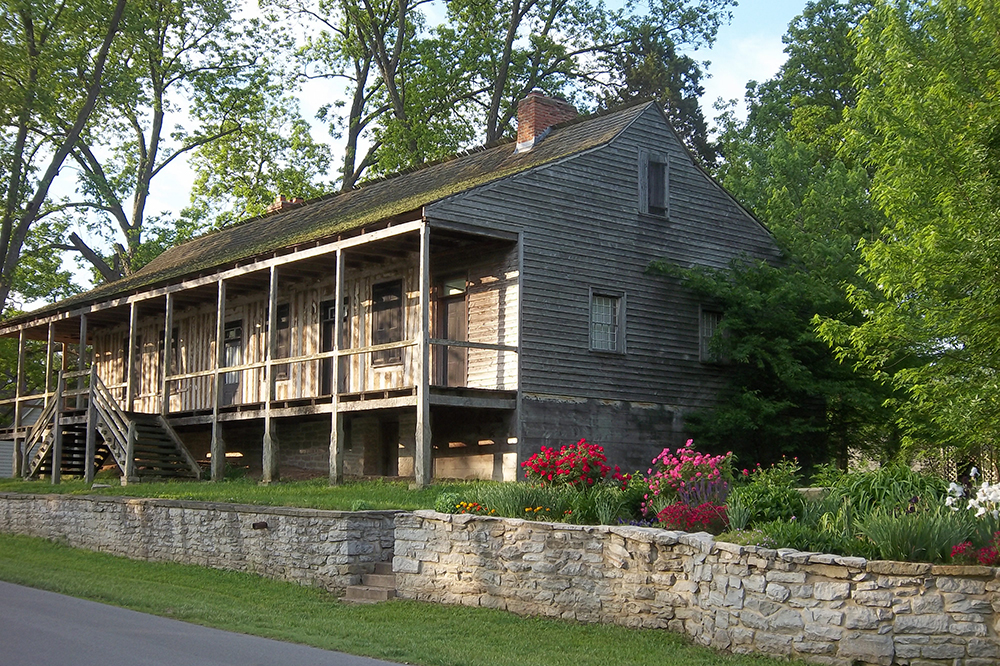
Green Tree Tavern exemplifies a construction method rarely seen today: poteaux-sur-sole, or “post-on-sill.” This French colonial technique features vertical logs placed on a wooden sill that rests on a stone foundation, rather than the horizontal log construction common in American pioneer building.
The vertical logs are hand-hewn white oak, and the spaces between them are filled with bousillage—a mixture of mud, straw, grass, and animal hair that provides insulation and structural stability. This construction method was practical for the Mississippi River valley climate and reflected building traditions the French colonists brought from Canada and earlier French settlements.
Green Tree Tavern’s design strays from typical French colonial patterns by including a large central room flanked by two or three smaller rooms, rather than the usual two to four rooms of roughly equal size. The house originally featured two triangular fireplaces, a wraparound galerie (porch), and a raised basement—all characteristic elements of French colonial architecture adapted to the American frontier.
Interestingly, Green Tree Tavern also shows Anglo-American influence in its construction details. It features pegged Anglo-American rafters instead of the Norman truss system traditionally used in French houses in the region. This hybrid construction makes it what architectural historians call an Anglo-French transitional house with Federal style details—physical evidence of cultural blending happening in real time as American influence grew after the Louisiana Purchase.
The building’s exterior walls remain visible on portions of the structure, allowing visitors to clearly see the vertical log construction that defines French colonial architecture. This visibility is increasingly rare; many historic structures have been covered with modern siding or deteriorated beyond recognition, making Green Tree Tavern’s exposed logs invaluable for understanding historical building techniques.
Scientific Dating and Historical Verification
For decades, historians believed Green Tree Tavern to be among Ste. Genevieve’s oldest structures, but definitive proof came through dendrochronology—the scientific dating of wood by analyzing tree ring patterns. Five wood samples from the building were tested, and the results confirmed construction began in 1790, making Green Tree Tavern the oldest surviving structure in Ste. Genevieve and the oldest verified building in Missouri.
This scientific verification matters because many historic buildings have legendary founding dates that don’t withstand scrutiny. Dendrochronology provides irrefutable evidence by matching the tree ring patterns in building timbers to master chronologies developed from trees with known growth years. The Green Tree Tavern samples showed the trees were felled in 1790, establishing the construction date with certainty.
Preservation, Restoration, and Rediscovery
Green Tree Tavern’s journey through the twentieth century reflects broader patterns in historic preservation. In 1938, the Historic American Buildings Survey documented the structure under the direction of Alexander Piaget and Charles van Ravenswaay, recognizing its architectural and historical significance. The building was listed on the National Register of Historic Places as part of the Ste. Genevieve Historic District, which was designated a National Historic Landmark.
The 1993 Mississippi River flood caused significant damage to the building, particularly the gallery posts. This disaster, while devastating, led to important discoveries during subsequent restoration work. Beginning in 1996 under owner Hilliard J. Goldman, extensive restoration efforts uncovered the historical graffiti and Masonic symbols mentioned earlier. The restoration also reconstructed elements that had been removed in an 1860s renovation, including the second triangular fireplace and a missing staircase, returning the building closer to its original configuration.
In 2017, the State of Missouri acquired the property, recognizing its irreplaceable historical value. Just three years later, in 2020, it transferred to the National Park Service as part of the newly established Ste. Genevieve National Historical Park. This transfer ensures professional stewardship and public access to one of Missouri’s most significant historic structures.
Visiting Green Tree Tavern Today
Green Tree Tavern now welcomes visitors as part of Ste. Genevieve National Historical Park, which was authorized by Congress in 2018 and formally established on October 30, 2020. The park preserves several historic structures that together tell the story of the first permanent European settlement in Missouri and the diverse people who built, shaped, and inhabited this Mississippi River community.
Practical Information:
Grounds Access: The grounds of Green Tree Tavern are open year-round, allowing visitors to view the exterior architecture and setting even when interior tours aren’t available.
Interior Tours: Free ranger-guided tours are offered daily, depending on staffing and weather conditions. Tours are limited to 15 people and require free tickets, which are available on a first-come, first-served basis at the Ste. Genevieve Welcome Center at 66 S. Main Street.
Important Note: Tour sign-ups close five minutes before the listed start time, so arrive at the Welcome Center with enough buffer time to secure your tickets.
Accessibility: Visitors should be aware that there are eight steps with no handrail to reach the grounds, followed by an additional nine steps with handrails to reach the entrance. Currently, the home is not wheelchair accessible, though the National Park Service continues working to improve accessibility throughout the park.
Admission: All programs at Ste. Genevieve National Historical Park, including house tours, are completely free.
Park Hours: The park is open daily from 9 a.m. to 5 p.m., closed on Thanksgiving Day, December 25, and New Year’s Day.
Getting Tickets: Stop by the Ste. Genevieve Welcome Center at 66 S. Main Street to watch the excellent 10-minute park film, view the detailed 1832 diorama of the town by famed artist, Lewis Pruneau, speak with rangers, and secure your tickets for Green Tree Tavern and other historic house tours.
Group Tours: Groups of 15 or more must make advance reservations by calling 573-880-7189 or emailing the park.
What to Expect on Your Tour
Ranger-led tours of Green Tree Tavern typically last 30-45 minutes and provide rich context about the building’s architecture, the families who lived here, and the broader history of Ste. Genevieve. Rangers are knowledgeable about French colonial construction techniques, the enslaved individuals who lived and worked at the site, the Masonic Lodge history, and how the building reflects the cultural transitions that shaped the region.
The tour highlights include:
- Architectural Details: Close examination of the poteaux-sur-sole construction, with visible vertical logs and explanations of building techniques
- Multiple Historical Layers: Stories spanning from French colonial settlement through German immigration and American expansion
- Personal Histories: Accounts of the Janis and Ziegler families, the enslaved people who worked here, and the Masons who gathered in these rooms
- Cultural Context: How Green Tree Tavern reflects the broader story of Ste. Genevieve’s transformation from French settlement to multicultural frontier town
Rangers encourage questions and tailor tours to visitor interests, whether you’re fascinated by architecture, social history, material culture, or the specific individuals who occupied this space.
Why Green Tree Tavern Matters
In an era when historic buildings disappear regularly to development or neglect, Green Tree Tavern’s survival and preservation represent a triumph for cultural heritage. This building matters for multiple reasons:
Architectural Rarity: As one of only a handful of surviving vertical log structures in the United States, Green Tree Tavern preserves construction techniques that were once common in French colonial settlements but have nearly vanished from the American landscape. Architecture students, historians, and preservationists study this building to understand French colonial building methods.
Cultural Convergence: The building embodies the meeting and mingling of French, American, and German cultures. Its hybrid construction techniques, multiple uses, and succession of owners from different backgrounds make it a physical record of cultural adaptation and change.
Complete Historical Record: Unlike many historic sites that preserve only the stories of wealthy or powerful residents, Green Tree Tavern’s documented history includes enslaved people, immigrant families, fraternal organizations, and various working-class proprietors. This completeness provides a more honest, complex picture of frontier life.
Verified Authenticity: The scientific dating and extensive documentation remove doubt about the building’s age and significance. This isn’t legendary history—it’s verified, studied, and confirmed.
Accessible History: As part of a National Historical Park with free admission, Green Tree Tavern is genuinely accessible to all Americans. The National Park Service’s interpretive programming ensures that visitors don’t just see old logs—they understand the human stories and historical forces those logs represent.
Context: Exploring More of Ste. Genevieve’s History
Green Tree Tavern is one of three historic houses currently managed by Ste. Genevieve National Historical Park, along with the Bauvais-Amoureux House and the Jean Baptiste Vallé House. Together, these structures represent different construction methods and historical periods, offering visitors a comprehensive view of French colonial architecture and frontier life.
The town of Ste. Genevieve itself rewards exploration. Beyond the National Park sites, visitors can discover the Centre for French Colonial Life, Felix Vallé House State Historic Site operated by Missouri State Parks, numerous privately owned historic structures, local wineries, restaurants serving traditional French and German cuisine, and seasonal festivals celebrating the town’s multicultural heritage.
Many visitors find that Ste. Genevieve offers a more intimate, less commercialized alternative to larger historical destinations. You can walk the same streets that Nicolas Janis and Clarisse and François and Mathias Ziegler walked, see buildings they saw, and gain genuine understanding of how people lived on the American frontier.
Plan Your Visit
Green Tree Tavern rewards visitors who come prepared to engage with complex history. This isn’t a glamorous plantation or a famous battlefield—it’s the actual home of actual people whose daily lives, struggles, successes, and relationships shaped a frontier community. The stories here include uncomfortable truths about slavery alongside accounts of immigrant hope, cultural adaptation, and community building.
The best approach is to start at the Ste. Genevieve Welcome Center, watch the park film, speak with rangers about your interests, and secure tickets for all the house tours. Plan to spend at least 2-3 hours exploring the park sites, and consider extending your visit to explore the broader town and its offerings.
For those interested in French colonial history, frontier settlement patterns, architectural preservation, or the complex social history of early America, Green Tree Tavern provides an unmatched opportunity to step inside the oldest verified building in Missouri and connect directly with the people and forces that shaped the nation’s westward expansion.
The vertical logs that Nicolas Janis and his workers raised in 1790 still stand, weathered but enduring, holding stories of enslavement and freedom, French tradition and American transformation, family life and fraternal brotherhood, tobacco commerce and Masonic ritual. These logs have witnessed 235 years of American history—and they’re waiting for you to discover their stories.
Sorry, no records were found. Please adjust your search criteria and try again.
Sorry, unable to load the Maps API.