



Sainte Genevieve Memorial Cemetery – Missouri’s Oldest Cemetery
Most historic cemeteries offer orderly rows of weathered headstones, carefully maintained grounds, and clear boundaries separating the living from the dead. Memorial Cemetery operates differently. This is a 5th and Merchant Streets hillside where more than 3,500 people—perhaps up to 5,000—lie in graves that are mostly unmarked, their wooden crosses having rotted away over the 235+ years since the cemetery’s establishment in 1787. The oldest marked grave belongs to Louis Le Clere (dated 1796, though burials certainly occurred earlier), and remarkably, burials continued 15 years after the official 1882 closure when the cemetery had become so crowded and weedy that it posed a health hazard. This is where Missouri’s territorial representative John Scott rests alongside French commandant Jean Baptiste Vallé, where Revolutionary War soldier Jacques Misse sleeps near Civil War Colonel killed at Shiloh, where enslaved people lie in their enslavers’ plots while free African Americans and Native Americans occupy the uphill section, and where Senator Lewis Linn was buried three times—the third interment occurring in 1938 when his nearly 100-year-old corpse was found remarkably preserved in its air-tight, lead-lined coffin, and people lined up to view his face through the window in the lid.
The cemetery functions as a physical record of Sainte Geneviève’s entire history compressed into a hillside landscape. The middle third—the oldest section—served Catholics in the French colonial period when the town was overwhelmingly French and universally Catholic. The uphill addition accommodated Protestants, Native Americans, victims of a steamship explosion, and others as the territory diversified following the Louisiana Purchase. The downhill section represents the final expansion before the cemetery reached capacity and forced the 1882 closure that led to the establishment of new cemeteries: Valle Spring (Catholic), Lutheran Cemetery, and Crestlawn (others). Walking through Memorial Cemetery means traversing 235 years of deaths, conflicts, epidemics, accidents, and the ordinary endings that befell French colonists, Spanish administrators, American pioneers, enslaved people, Indigenous peoples, steamboat passengers, soldiers, senators, and thousands of ordinary residents whose names are lost but whose presence created the foundation upon which contemporary Sainte Geneviève stands.
For visitors, Memorial Cemetery offers an experience that polished, manicured historic cemeteries cannot provide: authentic encounter with death as it was actually experienced in frontier and early American periods—crowded, sometimes chaotic, stratified by class and race, vulnerable to neglect and overgrowth, and ultimately abandoned when urban growth made the practice of burying the dead within town limits untenable. The cemetery is both beautiful and unsettling, peaceful and haunted by the stories of those who lie in unmarked graves, and essential for understanding Sainte Geneviève’s complete history rather than the sanitized version presented in restored French colonial houses.
Missouri’s Oldest Cemetery West of the Mississippi River
Memorial Cemetery’s establishment in 1787 makes it the oldest cemetery west of the Mississippi River in Missouri and one of the oldest European burial grounds in the entire trans-Mississippi region. Understanding the significance of this date requires contextualizing it within the broader timeline of European colonization in the area.
By 1787, Sainte Geneviève had existed for approximately 40-50 years (the exact founding date is debated, with 1735 being the commonly accepted year). The town had survived under French colonial administration, transitioned to Spanish control in 1762 following the Treaty of Paris, and by 1787 was a thriving agricultural community producing wheat for export to Lower Louisiana. The decision to establish a formal cemetery reflected the town’s maturation from temporary settlement to permanent community with the infrastructure—church, government, commerce, and yes, cemetery—that permanent settlements require.
The 1787 date predates:
- The United States Constitution (ratified 1788)
- The Louisiana Purchase (1803)
- Missouri statehood (1821)
- The vast majority of American western expansion
When Memorial Cemetery was established, George Washington had not yet become president. The American frontier lay hundreds of miles to the east. Sainte Geneviève was a Spanish colonial town in Upper Louisiana, administratively connected to New Orleans and culturally tied to French Canada and French colonial traditions rather than the English-speaking American republic that would eventually absorb it.
The cemetery’s age means it contains the physical remains of people who lived under three different governments (French, Spanish, American), who witnessed the Louisiana Purchase transform their status from Spanish colonial subjects to American citizens overnight, who remembered when Sainte Geneviève was the westernmost edge of European settlement rather than a small town in the middle of the United States. Every grave from before 1803 belongs to someone who died before Missouri was American territory. Every burial from 1787 to 1821 predates Missouri statehood. These aren’t just old graves—they’re physical evidence of populations and communities that existed before the political structures, national identity, and territorial organization that contemporary Americans take for granted.
For visitors, the cemetery’s age creates an encounter with deep time. Standing in Memorial Cemetery is standing in a space that has served its function—receiving the dead—continuously for 235+ years. The trees that shade the graves are younger than the cemetery. The town’s street grid has changed around it. Buildings have been constructed, burned, demolished, and rebuilt. But the cemetery persists, accumulating bodies and stories in layers that create a vertical archive of Sainte Geneviève’s entire post-contact history.
The Unmarked Graves: 5,000 People, Mostly Anonymous
Perhaps Memorial Cemetery’s most haunting characteristic is the vast number of unmarked graves—people whose burial locations are known in the aggregate (they’re somewhere in the cemetery) but unknown specifically (which mound, which depression, which anonymous patch of ground holds whose remains?).
Why are most graves unmarked?
Wooden Crosses Rotted Away – The description explicitly notes that “most grave markers were wooden crosses that have rotted away leaving most graves unmarked.” Wood was the affordable, available material for most families marking loved ones’ graves. Stone markers required money, access to quarries or stonemasons, and the cultural expectation that permanent markers were necessary or desirable. For French colonial Catholic families, wooden crosses sufficed as burial markers—they served the immediate need to identify graves for family visits and prayers, but they weren’t intended to last centuries.
Wood deteriorates. Missouri’s climate—hot, humid summers and freezing winters—accelerates rot. Within 50-100 years, wooden markers collapse, fragment, and disappear into the soil, leaving no trace of the graves they marked. The thousands of burials that occurred between 1787 and 1882 (95 years of continuous use) have largely lost their markers through simple environmental degradation.
Economic Constraints – Many people buried in Memorial Cemetery were not wealthy. French colonial habitants (farmer-settlers), enslaved people, laborers, children who died in infancy, victims of epidemics and accidents—these populations couldn’t afford expensive stone markers even if they’d wanted them. The grave marker budget for most families was zero or near-zero, making wooden crosses the only practical option.
Cultural Practices – French colonial Catholic burial practices emphasized Christian burial in consecrated ground more than permanent individual memorialization. The community’s collective memory maintained knowledge of who was buried where for a generation or two, but long-term preservation of individual grave locations wasn’t always priority. The important thing was burial in the Catholic cemetery with proper religious rites, not the creation of permanent monuments.
Cemetery Neglect – The description mentions that by the time Senator Linn was first moved in the 1840s, the cemetery had “become quite weedy and overgrown.” Periodic neglect meant that even markers that might have survived longer with proper maintenance deteriorated faster when vegetation overgrew them, soil shifted, and general upkeep ceased. Once markers fell and became buried under leaves, grass, and soil accumulation, recovering them became impossible.
The Result: Demographic Anonymity
The unmarked graves create a cemetery where we know the population existed (5,000 bodies are buried somewhere in this space) but cannot identify most individuals. We can estimate the demographic composition—predominantly French Catholic colonists in the earliest period, diversifying to include Protestants, enslaved people, Native Americans, and American settlers in later periods—but we cannot name most of the dead or locate their specific graves.
This anonymity serves as a sobering reminder that most human lives, even in relatively recent historical periods, leave minimal physical trace. The senators, commandants, and prominent citizens who merited stone markers (or whose families could afford them) represent the tiny minority whose names survive. The vast majority—ordinary farmers, laborers, women dying in childbirth, children succumbing to disease, enslaved people whose names were never recorded—disappear into collective anonymity despite their physical remains persisting in the soil.
For visitors, walking through Memorial Cemetery means walking over thousands of unmarked graves. Every step could be above someone’s final resting place. The mounds and depressions scattered throughout the grounds often indicate grave locations even when markers are absent—the slight rise where soil was mounded over a coffin, the subtle depression where earth settled into the space a decomposed coffin left. Reading the landscape itself becomes the only way to perceive the extent of the burials beyond the minority of marked graves.
The Notable Burials: Senators, Commandants, and Preserved Corpses
While most Memorial Cemetery residents are anonymous, several notable burials create the historical narrative that gives the cemetery broader significance:
Senator Lewis Linn: The Thrice-Buried “Model Senator”
Dr. Lewis Linn’s burial history is one of Memorial Cemetery’s most remarkable stories, combining political prominence, cemetery maintenance issues, and the macabre discovery of a nearly 100-year-old preserved corpse.
First Burial (1843): Senator Lewis Linn, described as the “model senator” for his representation of Missouri interests, died and was buried in Memorial Cemetery in 1843. Linn had served in the U.S. Senate from 1833 until his death, championing Missouri’s interests and supporting westward expansion including the Oregon Territory settlement. His burial in Memorial Cemetery followed the standard practice of prominent citizens receiving interment in the town’s principal cemetery.
Second Burial (1840s-1850s): By the 1840s-1850s, Memorial Cemetery had become “quite weedy and overgrown”—a common pattern when cemeteries filled to capacity and maintenance became difficult or neglected. The condition was considered unseemly for burying Missouri’s distinguished senator, so Linn was exhumed and moved to the new Valle Springs Cemetery nearby. This reburial reflected both the practical need for new cemetery space and the desire to honor prominent citizens with burial in well-maintained grounds rather than the deteriorating older cemetery.
Third Burial (1938): After Memorial Cemetery was cleaned up (presumably in the 1930s as part of Depression-era public works projects or historical preservation efforts), the decision was made to return Senator Linn to his original resting place. When the coffin was opened during the 1938 exhumation, observers discovered that Linn’s corpse was “remarkably preserved” in his air-tight, lead-lined coffin. Nearly 100 years after death, his body remained recognizable enough that “people lined up to view his face through the window in the lid.”
The preservation resulted from the lead-lined coffin creating an airtight seal that prevented oxygen from reaching the body. Without oxygen, the bacteria that normally cause decomposition cannot function efficiently. The lead lining also prevented moisture, insects, and other environmental factors from accessing the corpse. The result: something approaching mummification, where the body desiccates rather than putrefying, leaving skin, hair, and facial features recognizable even after decades.
The public viewing of Senator Linn’s preserved corpse through the coffin window represents a 1930s sensibility about death, celebrity, and public spectacle that seems shocking by contemporary standards. The willingness to open a century-old grave, examine the contents, and then invite public viewing demonstrates how attitudes toward death, bodily integrity, and the boundary between the living and the dead have shifted over the past 85 years.
Odile Vallé: The Benefactor Who Chose Memorial Cemetery
Odile Vallé’s burial represents the opposite pattern from Senator Linn—instead of being moved away from the deteriorating old cemetery, she specifically requested burial in Memorial Cemetery despite it being officially closed, and she was willing to pay handsomely for the privilege.
Odile was the wife of Felix Vallé, the prominent merchant whose Federal-style limestone house (built 1818) now serves as the centerpiece of the Felix Vallé State Historic Site. When Odile died (date not specified in the description), Memorial Cemetery had been officially closed since May 1882. New burials were supposed to occur in Valle Spring Cemetery (Catholic), Lutheran Cemetery, or Crestlawn Cemetery (others).
However, Odile wished to be buried beside her prominent husband Felix in Memorial Cemetery where he was already interred. To achieve this wish, she (presumably through her will or her estate) made an extraordinary exchange:
- Donated land for the new cemetery (likely Valle Spring Cemetery, given the name)
- Donated “an enormous sum” for the construction of the new brick Catholic Church
The church donation was particularly significant. The Catholic Church has been central to Sainte Geneviève since the town’s founding, and the construction of a new brick church (replacing whatever earlier structure existed) required substantial funding. Odile’s “enormous sum” presumably helped make this construction possible, demonstrating both her personal wealth and her willingness to leverage that wealth to secure her preferred burial location.
The exchange worked. Odile was buried in Memorial Cemetery with Felix, becoming one of the post-1882 interments that violated the official closure but were permitted due to special circumstances and generous compensation to the community.
Odile’s story demonstrates how wealth and social prominence could override rules even in death—ordinary residents couldn’t choose to be buried in the closed cemetery, but someone who could donate land and fund church construction could secure special dispensation.
Other Notable Burials:
John Scott – Missouri’s last territorial representative and first Congressman, representing Missouri’s transition from territory to state. Scott served in Congress from 1821 to 1827, making him a bridge figure between Missouri’s frontier period and its incorporation into the United States as a full state.
Jean Baptiste Vallé – The last French commandant of the area under Spanish administration. Vallé represented the French colonial elite who maintained positions of authority even under Spanish rule, demonstrating the continuity of French influence despite the change in imperial administration.
Jacques Misse – An American Revolutionary War soldier, buried far from the Revolutionary battlefields along the Atlantic coast. Misse’s presence in Sainte Geneviève demonstrates the westward migration of Revolutionary War veterans who received land grants or simply sought opportunities in frontier territories after the war.
Civil War Colonel – Killed at the Battle of Shiloh (April 1862), one of the Civil War’s bloodiest battles. The colonel’s burial in Memorial Cemetery represents Missouri’s complex Civil War experience as a border state with divided loyalties, Union and Confederate sympathizers, and soldiers fighting on both sides.
These notable burials create the narrative framework that makes Memorial Cemetery historically significant beyond its function as the town’s burial ground. The cemetery contains people who shaped Missouri’s political development, who represented different waves of settlement and different cultural traditions, and whose lives spanned from the colonial period through the Civil War.
The Cemetery’s Layout: Three Sections Reflecting Social Stratification
Memorial Cemetery’s physical organization reveals the social hierarchies and religious divisions that structured 18th and 19th-century Sainte Geneviève:
The Middle Third: The Original Catholic Section
The oldest part of the cemetery occupies the middle third of the current grounds. This section was established in 1787 when Sainte Geneviève was overwhelmingly French and universally Catholic. The Catholic Church controlled burial practices, and interment in consecrated ground required Catholic baptism and adherence to church rules about proper Christian death (no suicides, no excommunicated persons, etc.).
This section contains the earliest burials, the highest concentration of French colonial families, and the core of Sainte Geneviève’s founding population. The graves here represent people who lived entirely under French or Spanish colonial administration, who spoke French as their primary language, who practiced Catholicism as the only religion they’d ever known, and who could not have imagined that their small agricultural settlement would eventually be absorbed into an English-speaking American republic.
The Uphill Section: Protestants, Native Americans, and Others
As Sainte Geneviève’s population diversified following the Louisiana Purchase (1803), the cemetery needed space for non-Catholics. An uphill section was added to accommodate:
Victims of a Steamship Explosion – Mass casualty events from steamboat disasters (common in the Mississippi River steamboat era from the 1810s-1860s) required burial space for multiple victims simultaneously. The uphill section received these burials, separating the violent, sudden deaths from the ordinary burials in the Catholic section.
Native Americans – Indigenous people who died in or near Sainte Geneviève received burial in this section. The cemetery’s willingness to bury Native Americans (rather than excluding them entirely) reflects some degree of cultural accommodation, though the segregation to a separate section demonstrates they weren’t fully integrated into the Catholic community burial practices.
African Americans – “Some African slaves are buried there as well, while others lay at peace in their enslaver’s plot.” The description reveals the complex, stratified burial practices regarding enslaved people. Some were buried in a separate section (the uphill area) while others were buried in their enslavers’ family plots—proximity in death reflecting the enslaved person’s role in the enslaving family’s household. This dual practice demonstrates how slavery’s hierarchies persisted even in burial, with enslaved people’s final resting places determined by their owners’ preferences rather than their own or their families’ wishes.
Protestant Settlers – German, Irish, Scottish, and Anglo-American settlers who arrived after the Louisiana Purchase often practiced Protestant Christianity (Lutheran, Presbyterian, Methodist, etc.). These groups needed burial space but couldn’t use the Catholic section. The uphill addition accommodated this religious diversity while maintaining separation between Catholic and Protestant burials.
The Downhill Section: The Final Expansion
When the original and uphill sections filled to capacity, a downhill parcel was added as the final expansion before the cemetery was permanently closed in 1882. This section likely contains the latest burials from the 1860s-1882 period, representing Sainte Geneviève’s Civil War generation and the immediate post-war decades.
The downhill section’s addition demonstrates the cemetery reaching its absolute maximum capacity—expanding in every direction (uphill and downhill from the original middle section) until no further expansion was possible or desirable within the town limits.
The Pattern: Segregation in Death
The cemetery’s three-section organization reveals how religious affiliation, race, and social status structured burial practices:
- Catholics in the consecrated middle section
- Non-Catholics, Native Americans, and some enslaved people in the uphill section
- Later burials regardless of status in the downhill final expansion
- Some enslaved people in their enslavers’ plots within the Catholic or other sections
This segregation was considered normal and proper in the 18th-19th centuries. Contemporary visitors might find it disturbing—the physical separation of the dead by race and religion, the burial of enslaved people in their enslavers’ plots as if they were family property even in death, the creation of a hierarchy of burial grounds where the Catholic section received prime location while others were relegated to additions.
The cemetery layout teaches uncomfortable lessons about how social structures—slavery, religious exclusion, racial hierarchy—extended beyond life to determine where and how people were buried, who could be buried near whom, and whose graves received consecration versus simple interment.
The 1882 Closure: When Death Became a Health Hazard
Memorial Cemetery’s closure in May 1882 resulted from the confluence of several factors:
Capacity: After 95 years of continuous use (1787-1882) and three expansions (middle, uphill, downhill sections), the cemetery had simply run out of space. Every available plot was filled or claimed, leaving no room for additional burials without disturbing existing graves—a practice considered unacceptable.
Health Concerns: By the 1880s, public health reformers were identifying urban cemeteries as potential disease vectors. The concern was that decomposing bodies contaminated groundwater, that the concentration of graves in limited space created sanitation hazards, and that cemeteries within town limits posed risks to living populations. The description notes the cemetery “became a health hazard,” reflecting these 19th-century public health concerns.
Location: Memorial Cemetery sits at 5th and Merchant Streets—within the developed portion of Sainte Geneviève. As the town grew, the cemetery’s central location became problematic. New cemeteries were established outside town limits, following the emerging practice (still common today) of locating burial grounds at the edges of settled areas rather than within residential neighborhoods.
Condition: The “weedy and overgrown” condition that prompted Senator Linn’s first move demonstrates maintenance challenges. A cemetery that’s full, that serves no new burials, and that has thousands of unmarked graves becomes difficult to maintain. Without ongoing burials bringing families to tend plots, the cemetery risks deterioration and neglect.
The Solution: Three New Cemeteries
The 1882 closure coincided with the establishment of three new cemeteries serving different religious communities:
Valle Spring Cemetery – For Catholics, continuing the tradition of denominational burial grounds. The name suggests Odile Vallé’s land donation contributed to this cemetery’s creation.
Lutheran Cemetery – For Sainte Geneviève’s significant German Lutheran population, providing consecrated burial ground for this Protestant denomination.
Crestlawn Cemetery – For “others,” meaning people who didn’t fit into Catholic or Lutheran categories—other Protestant denominations, non-religious individuals, or anyone who preferred a non-denominational burial ground.
This three-cemetery solution accommodated Sainte Geneviève’s religious diversity while maintaining the denominational segregation that characterized 19th-century burial practices. Catholics, Lutherans, and others could each have burial grounds consecrated according to their traditions and managed by their religious communities or by secular associations aligned with their preferences.
The Post-Closure Burials:
Despite the May 1882 official closure, the description notes burials continued “15 years after the cemetery was officially closed.” These post-1882 interments (up to 1897) were exceptions granted for special circumstances:
- Odile Vallé’s wish to be buried with Felix (paid for through enormous donations)
- Senator Linn’s third burial in 1938 (56 years after closure, but justified as historical restoration)
- Other unspecified burials involving people with strong claims to Memorial Cemetery plots
These exceptions demonstrate that cemetery closures aren’t absolute—strong enough justification (wealth, prominence, historical significance, family plots) can override regulations, especially when the cemetery is no longer functioning as an active burial ground and occasional special interments don’t meaningfully worsen the conditions that prompted the closure.
Visiting Memorial Cemetery Today
Memorial Cemetery remains accessible to visitors, operating as a public historical site and park-like space maintained by the city or historical organizations.
Location: 5th & Merchant Streets, Ste. Genevieve, MO 63670 Hours: Open daily until dusk Admission: Free (cemeteries are public spaces) Contact: 573-883-7544
What to Experience:
The Landscape of Death – Walk the grounds recognizing that you’re moving through 5,000 graves, most unmarked. The mounds, depressions, and occasional stone markers create a physical record of 235 years of deaths.
The Marked Graves – Seek out the surviving stone markers, reading names, dates, inscriptions, and epitaphs. Notice the craftsmanship variations—elaborate carved stones for wealthy families, simple slabs for modest burials.
The Oldest Grave – Find Louis Le Clere’s marker (1796), though remember that burials certainly occurred earlier given the cemetery’s 1787 establishment.
The Notable Burials – Locate Senator Lewis Linn, Odile and Felix Vallé, John Scott, Jean Baptiste Vallé, and other prominent citizens whose markers survive.
The Sections – Notice the topography distinguishing the middle, uphill, and downhill sections. Consider how this layout reflected social and religious hierarchies.
The Trees and Vegetation – The mature trees shading the cemetery are themselves historical entities, some possibly planted in the 19th century and all serving as living markers of the passage of time.
The Adjacent Historic District – Memorial Cemetery sits within blocks of Sainte Geneviève’s National Historic Landmark District, allowing easy combination of cemetery visit with touring French colonial houses.
The Bird Sanctuary Designation – Memorial Cemetery functions as an unofficial bird sanctuary, with mature trees and diverse vegetation attracting species that have become rare in developed areas. The cemetery’s quiet, undisturbed character makes it excellent for birdwatching.
Visitor Etiquette:
Respect the Dead – Remember this is a burial ground, not just a park. Avoid walking directly on marked graves when possible, speak quietly, and treat the space with appropriate reverence.
Preserve the Markers – Don’t touch or rub stone markers (oils from hands can damage limestone and marble). Don’t move objects or attempt to “clean” markers without expertise.
Leave No Trace – Pack out any trash, stay on established paths where they exist, and don’t disturb vegetation or wildlife.
Photography – Taking photographs is generally acceptable, but consider whether posting images of specific graves on social media respects the deceased and their descendants.
Research Opportunities – Memorial Cemetery attracts genealogists researching Sainte Geneviève ancestors, historians studying burial practices and demographic patterns, and preservationists documenting surviving markers before weathering renders them illegible.
The Foundation’s Stewardship: From Neglect to National Recognition
The Foundation for Restoration of Ste. Genevieve has managed Memorial Cemetery’s preservation since 1995, when the Catholic Archdiocese of St. Louis deeded the cemetery to the City of Ste. Genevieve, which in turn contracted with the Foundation to provide restoration and management in perpetuity. This arrangement formalized decades of grassroots preservation efforts that began in the late 1960s when local historian Lucille Basler advocated for the cemetery’s significance and led fundraising campaigns to repair monuments, remove overgrown brush, and plant new shrubs and trees. Prior to the Foundation’s involvement, Memorial Cemetery had suffered cycles of neglect and revival—brief attention during the 1935 bicentennial celebration brought new stone entryway gates on Fifth Street and monument repairs, but enthusiasm waned with World War II, leaving the cemetery vulnerable to vandalism, decay, and the general deterioration that befalls abandoned burial grounds. The Foundation’s permanent stewardship ended these cycles, ensuring that Missouri’s oldest cemetery would receive consistent professional care rather than sporadic volunteer attention.
The Save America’s Treasures Grant: Professional Restoration
In 2004, the Foundation secured a major preservation milestone when it received a “Save America’s Treasures” grant administered through the National Park Service—federal recognition that Memorial Cemetery qualified as a nationally significant cultural resource worthy of preservation funding. These federal funds, matched by local contributions, enabled comprehensive restoration work that transformed the cemetery from a historically important but physically deteriorating site into a professionally maintained historic landscape. The grant funded monument restoration using proper conservation techniques that stabilize fragile limestone and marble markers without causing further damage, the creation of accessible paths allowing visitors to explore the cemetery without trampling unmarked graves, the installation of benches providing places for contemplation and rest, thoughtful landscaping that balances historical authenticity with visitor experience, and crucially, basic research and interpretation that documents the cemetery’s history, identifies burial locations where possible, and creates educational materials explaining the site’s significance to visitors who might otherwise see only weathered stones and overgrown grounds.
Annual Programming: The Déjà Vu Spirit Reunion
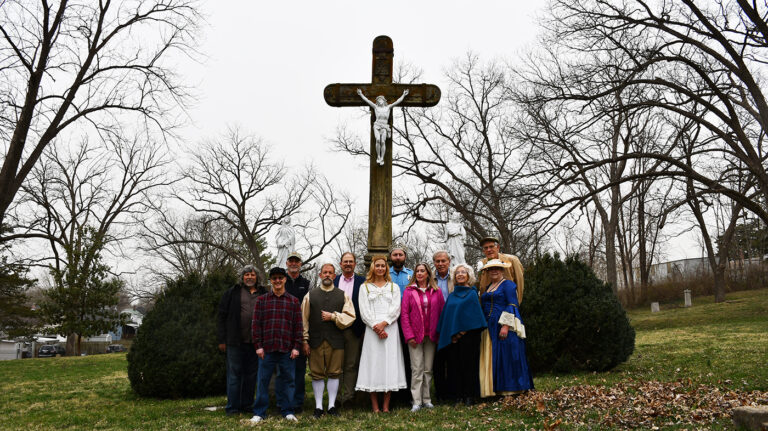
Beyond physical preservation, the Foundation brings Memorial Cemetery to life through the annual Déjà Vu Spirit Reunion, a lantern-lit educational event held near Halloween where visitors explore the cemetery by evening light while encountering local people in period costume standing near the graves of the historical figures they portray, sharing stories of the deceased’s lives, loves, and sometimes the circumstances of their deaths. This event serves multiple preservation functions: it generates public interest and support for the cemetery’s ongoing maintenance, it educates visitors about the specific individuals buried in Memorial Cemetery rather than presenting them as anonymous historical dead, it creates emotional connection between contemporary community members and their predecessors, and it demonstrates that preservation isn’t just about maintaining physical structures but about keeping history alive through storytelling and interpretation. The Foundation’s work—combining professional conservation, secure funding mechanisms, public programming, and volunteer engagement including cemetery clean-up events with preservationists teaching proper tombstone cleaning techniques—ensures that Memorial Cemetery will continue functioning as both a sacred burial ground and an educational resource that captivates visitors and townspeople alike, preserving the stories of 5,000 souls who built the foundation of Missouri’s oldest permanent European settlement.
Why Memorial Cemetery Matters
Memorial Cemetery serves multiple important functions:
Historical Record – The cemetery physically documents Sainte Geneviève’s population from 1787 to 1882, preserving demographic information about who lived, who died, family structures, infant mortality patterns, epidemic deaths, and the community’s growth.
Cultural Continuity – The cemetery connects contemporary Sainte Geneviève to its colonial past through the unbroken presence of the dead. The French colonists buried in 1790 lie in the same ground as Civil War soldiers buried in 1865—physical continuity spanning 75+ years of dramatic change.
Social History – The cemetery’s layout and burial patterns reveal social hierarchies, religious divisions, racial structures, and economic inequalities that historical documents sometimes obscure or deny.
Memento Mori – The cemetery serves its timeless function of reminding the living of mortality, of the inevitability of death, and of the brevity of life. The thousands of unmarked graves demonstrate how quickly human existence fades from memory absent deliberate preservation efforts.
Public Space – The cemetery functions as park-like space offering quiet contemplation, nature observation, and escape from the commercial bustle of downtown Sainte Geneviève.
Educational Resource – School groups, historical societies, and visitors learn from the cemetery about burial practices, demographic history, and the material culture of death (gravestone styles, epitaphs, symbolic imagery).
A Final Resting Place for 5,000 Stories
Memorial Cemetery holds more than 5,000 bodies. It holds 5,000 individual stories—lives lived in joy and sorrow, in prosperity and poverty, in freedom and slavery, in health and disease, in infancy and old age. Most of these stories are lost. The wooden crosses rotted away. The names were never recorded or the records were destroyed. The families who tended graves died themselves, taking memory of the unmarked graves with them.
But the cemetery persists. The ground remains consecrated. The dead continue their rest beneath mature trees and grass-covered mounds. Visitors can walk the same paths that French colonists walked in 1800, that steamboat era residents walked in 1850, that Civil War generation families walked in 1870. The continuity of the cemetery as a space for the dead creates a bridge across 235 years of Sainte Geneviève’s history.
Visit Memorial Cemetery at 5th and Merchant Streets. Walk respectfully among the marked and unmarked graves. Consider the lives that ended here—the senator buried three times, the wealthy woman who bought her burial plot with an enormous church donation, the enslaved people buried in their enslavers’ plots, the steamboat victims interred en masse after explosion, the Native Americans and Protestants segregated to the uphill section, and the thousands of ordinary residents whose names and stories are lost but whose presence created the community that contemporary Sainte Geneviève inherits.
This is Missouri’s oldest cemetery west of the Mississippi River. This is where 235 years of deaths accumulated in layers. This is where the past literally rests beneath your feet—unmarked, mostly anonymous, but essential to understanding the complete history of Missouri’s oldest permanent European settlement.
Open daily until dusk. Open to the public. Located at 5th & Merchant Streets in historic downtown Sainte Geneviève, where the dead have rested since 1787 and continue resting still.


Sorry, no records were found. Please adjust your search criteria and try again.
Sorry, unable to load the Maps API.