

EKlekTix – Jean Rissover Became a Painter at 70 and Now Creates Narrative Art While You Watch
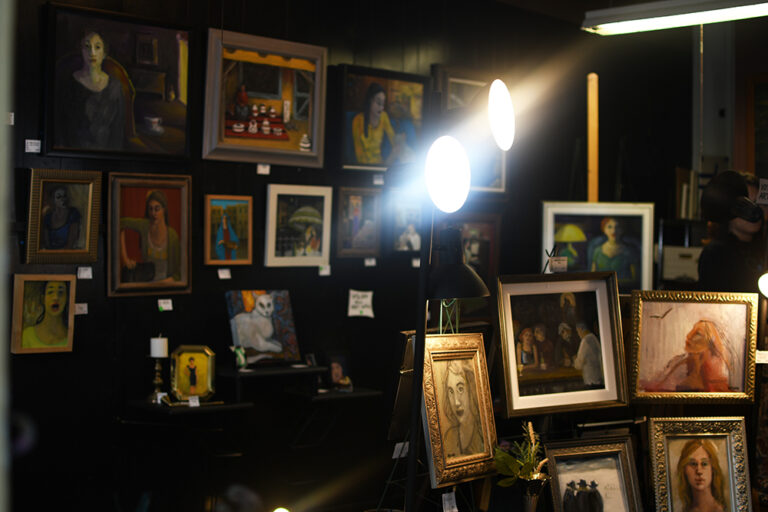
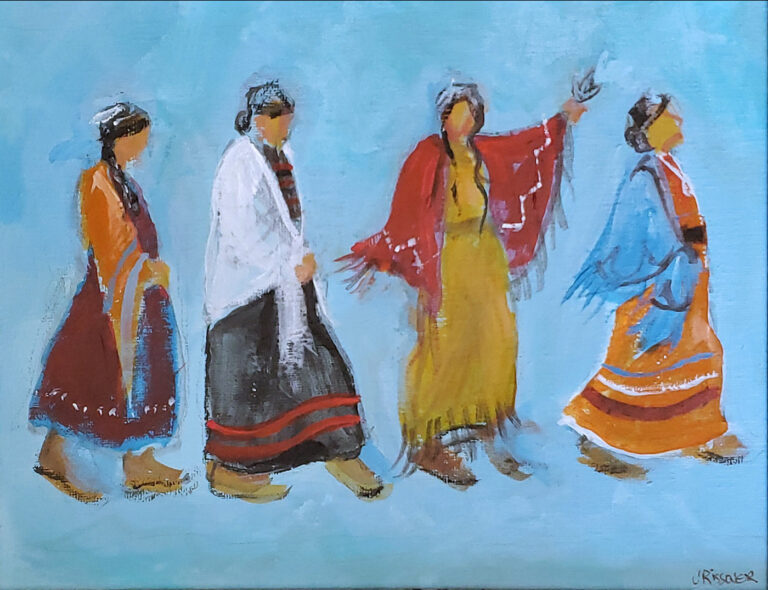
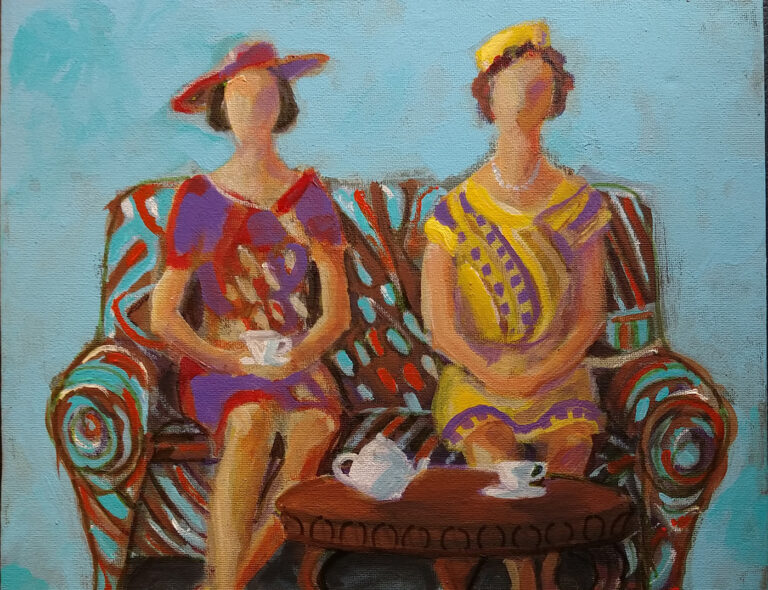
At 130 North Main Street in an 1860s building, Jean Rissover paints during the hours her gallery is open—not as demonstration or performance but as working artist fully engaged in creating the figurative paintings that crowd her studio walls. About 75 original oil paintings, most 11×14 inches or smaller, fill the space alongside eclectic giftware sourced from artisans around the world. The paintings tell stories, primarily of women—their activities, experiences, relationships, joys, sorrows, and moods—drawn from Rissover’s imagination populated by characters who “live in her head” and demand to be painted. Some focus on Sainte Geneviève’s French colonial history. Others explore universal experiences of being female across time and culture. All are narrative in nature, inviting viewers to construct stories around the figures Rissover portrays with loose, impressionistic brushwork that suggests rather than defines, leaving space for interpretation.
The remarkable part isn’t just the art—it’s the journey. Jean Rissover started painting in 2011 at age 70, after retiring from a career spanning teaching, social work, event organization, antique shop ownership, and managing editor of the Ste. Genevieve Herald. It was her first serious art creation since high school in suburban St. Louis. She describes it as taking “some nerve (and a wide optimistic streak)” to decide at 70 to become a painter. She ran out of room in her house within a few years from accumulated paintings. She opened EKlekTix (the name itself suggesting the eclectic nature of what you’ll find inside) to display her work, source interesting objects from distant places she’d like to visit, and paint where people could watch the creative process unfold. She’s won regional awards. She’s exhibited at the Arts Council of Southeast Missouri in Cape Girardeau. And she continues painting daily, creating new works while visitors browse, ask questions, and discover that becoming an artist at 70 isn’t just possible—it’s a model for what retirement can become when you finally have time to pursue what you’ve always wanted to do.
The Artist: Jean Rissover’s Unconventional Path
Jean Rissover’s biography reads like someone who lived fully before discovering her primary calling. Born and raised in North County St. Louis, she attended Washington University, lived in Gaslight Square (the fabulous, crazy St. Louis entertainment district that thrived in the 1960s), then Old Town Chicago, Minneapolis, Iowa City, and Kirkwood before settling in Sainte Geneviève in the early 1980s.
Over those decades, she worked variously as:
- Teacher – educating students in formal classroom settings
- Social worker – supporting vulnerable populations through difficult circumstances
- Event organizer – coordinating programs and gatherings (skills evident in her committee work organizing the 2022 Resurgence of the 1934 Ste. Genevieve Summer School of Art)
- Antique shop owner – running retail business and developing eye for objects with history and character
- Managing editor of the Ste. Genevieve Herald – overseeing local newspaper content, writing, editing, and maintaining connection to community stories
Each career developed skills that now inform her art. Teaching requires understanding how people learn and communicate. Social work demands empathy and insight into human experience. Event organization needs vision and execution. Antique dealing trains aesthetic judgment. Journalism teaches storytelling, observation, and distilling complex information into clear narratives.
When Rissover retired in 2011, she was 70 years old. Most people that age are winding down, settling into comfortable routines, traveling occasionally, enjoying grandchildren. Rissover rekindled her passion for art—dormant since high school—and committed to becoming a painter. Not a hobbyist. Not someone who paints occasionally. A painter. An artist creating work worthy of exhibition, recognition, and serious consideration.
She sought instruction from notable regional artists. She painted daily. She developed distinctive style—figurative work with impressionistic looseness, focusing on women’s lives and French colonial history. She exhibited publicly. She won awards. And within a few years, she had accumulated so many paintings that her house couldn’t contain them all.
The solution was EKlekTix—a studio/gallery space where she could display completed work, paint new pieces, and share the creative process with visitors while also curating interesting objects from around the world that reflected her eclectic aesthetic sensibility.
The Paintings: Narrative Art Focused on Women’s Lives
Jean Rissover describes her work as “narrative in nature”—paintings that tell stories or suggest narratives that viewers complete through their own interpretations. The paintings feature figures, primarily women, engaged in activities or captured in moments that reveal something about their interior lives.
Distaff: The Lives of Women
Rissover’s 2019 exhibition at the Arts Council of Southeast Missouri was titled “Distaff: The Lives of Women,” and her artist’s statement reveals both her thematic focus and her sharp awareness of how language and society have historically defined and limited women:
“‘Distaff’ is a wooden stick used in spinning, an art that was almost entirely the purview of women and so closely identified with their role that it became, and remains, a word descriptive of our entire sex as other and apart from the male. While our collective, everyday experience as women is the central theme of my art, I hope that idea stands alongside an understanding that as much as society would define us by our roles (or the roles denied to us), it is our individual courage and experience that determines who we really are. And when it comes to being ‘distaff,’ all of us, young women, girls, matrons, and old ladies like me, are much, much more than that.”
This statement reveals Rissover’s feminist consciousness—not strident or dogmatic, but grounded in lived experience and sharp observation of how women navigate societies that categorize and limit them. Her paintings portray women’s “activities, experiences, relationships, joys, sorrows, and moods”—the full spectrum of female human experience rather than idealized or sentimentalized versions.
French Colonial History
Some of Rissover’s work focuses specifically on Sainte Geneviève’s French colonial past. Living in a town where 18th-century French culture remains visible in architecture, place names, cultural traditions, and community memory, Rissover has access to stories and characters that most American artists never encounter. Her paintings likely depict colonial women engaged in domestic work, religious practice, social interaction, and the daily labor that sustained French settlements along the Mississippi River.
These historical paintings serve dual function—they’re beautiful objects in themselves, but they also preserve and communicate stories about people who left limited written records. Colonial women’s lives are often invisible in historical archives dominated by male political, economic, and military activities. Rissover’s imaginative reconstructions give them visual presence and narrative weight.
The Characters in Her Head
Rissover explains that she wants to “tell the stories of the different figures who live in her head.” This suggests that her creative process involves populating an internal landscape with characters who demand to be painted—not unlike how novelists describe characters who “take over” stories and insist on being written.
The paintings likely emerge from this dialogue between Rissover’s imagination and the figures inhabiting it. She’s not working from photographs or models (though she may reference them) but from imagined people whose stories she feels compelled to tell. This gives the work psychological depth and narrative complexity that purely observational painting might lack.
Style and Technique
Descriptions characterize Rissover’s work as “impressionistic”—meaning she paints with visible brushwork, loose handling, and emphasis on capturing light, color, and mood rather than photographic detail. Oil paint (her primary medium) allows rich color, subtle gradations, and the kind of surface texture that impressionistic technique requires.
The small scale (most paintings 11×14 inches or smaller) creates intimacy—these aren’t grand statements meant to dominate gallery walls but personal observations inviting close viewing and contemplation. The size also makes them accessible to collectors with limited wall space and more affordable than large-scale works.
The Studio Experience: Watch Her Paint
EKlekTix isn’t a conventional gallery where finished art hangs in silence. It’s a working studio where Jean Rissover paints during open hours, making the creative process visible and allowing visitors to ask questions, observe techniques, and understand how paintings develop from blank canvas to finished work.
Why This Matters:
Demystifies Art-Making – Many people view art creation as mysterious or requiring innate talent they lack. Watching Rissover paint demonstrates that it’s learned skill combined with practice, observation, and willingness to make mistakes and correct them.
Builds Connection – Meeting the artist who created the paintings you’re considering changes the purchasing experience from transaction to relationship. You’re not just buying a painting but supporting a specific person whose story you know and whose creative process you’ve witnessed.
Educational Value – Observing an experienced painter work teaches compositional choices, color mixing, brushwork techniques, and problem-solving strategies that books and videos cannot fully convey.
Validates Late-Life Creativity – Rissover’s presence as 80+ year old woman actively painting challenges ageist assumptions that creativity, productivity, and new learning belong exclusively to youth. She demonstrates that 70 is not too late to start something significant.
Encourages Questions and Dialogue – The studio setting invites conversation rather than the hushed silence some galleries cultivate. Visitors can ask about specific paintings, Rissover’s process, the stories behind particular works, or technical questions about materials and methods.
The Eclectic Giftware: Artisan Objects from Around the World
Beyond Rissover’s paintings, EKlekTix stocks “fun and sometimes funky accent pieces, many by artisans in faraway places” Rissover would like to visit. This eclectic curation reflects her aesthetic sensibility and creates what descriptions call “a sure bet to find a unique gift.”
What “Eclectic” Means:
The name EKlekTix celebrates eclecticism—assembling items from different sources, styles, cultures, and media based on quality, interest, and uniqueness rather than following single aesthetic or geographic focus. Walking into the gallery, you might find:
- Handcrafted ceramics from Mexico or Central America
- Textiles from South Asia or Africa
- Carved wooden objects from artisan communities
- Jewelry from various cultural traditions
- Decorative items reflecting crafts from distant places
The curation isn’t random but reflects Rissover’s decades as antique dealer (developing eye for quality and character), world traveler (or at least someone who appreciates global craft traditions), and artist (understanding what makes objects visually compelling).
Supporting Global Artisans:
By sourcing from artisans in faraway places, Rissover creates marketplace for craftspeople who might otherwise struggle to reach American consumers. The objects carry stories—where they were made, what techniques were used, what cultural traditions they represent. This transforms shopping from mere acquisition into cultural exchange and ethical consumption supporting traditional crafts.
Gift-Giving Solution:
The “sure bet to find a unique gift” promise addresses common frustration—finding gifts that aren’t generic mass-produced items that recipients could buy themselves but distinctive objects with character and story. The eclectic inventory means you’re unlikely to find the same items at conventional retailers, making EKlekTix gifts genuinely special.
The 1860s Building: Historic Space for Contemporary Art
EKlekTix occupies an 1860s building on North Main Street—part of Sainte Geneviève’s North Main Street Art and Entertainment District. The historic setting creates atmospheric context for both Rissover’s French colonial history paintings and the global artisan objects she curates.
Buildings from the 1860s witnessed:
- The Civil War and its aftermath
- The transition from frontier settlement to established town
- Multiple generations of commercial and residential use
- Sainte Geneviève’s evolution from French colonial outpost to American river town to preserved historic district
Using this space for contemporary art-making demonstrates how Sainte Geneviève’s historic buildings remain living, working structures rather than museum pieces. Rissover paints where 19th-century merchants sold goods, where families lived, where community life unfolded across 160+ years.
Practical Information
Location: 130 North Main Street, Ste. Genevieve, MO 63670
Hours: Saturday and Sunday, 10:00 AM – 3:00 PM (Also participates in 4th Friday Art Walk events, March-November, 6:00-9:00 PM)
Contact:
- Email: jrissoverart@gmail.com
- Phone: 573-330-2620
What to Experience:
The Paintings – Browse approximately 75 original oil paintings focusing on women’s lives and French colonial history, most 11×14 inches or smaller
Watch the Artist Work – See Jean Rissover paint during open hours, ask questions, observe creative process
Eclectic Giftware – Discover unique items sourced from global artisans, perfect for distinctive gifts
Artist Conversation – Talk with Rissover about her late-life journey to becoming a painter, her narrative approach, and the characters who live in her head
Historic Setting – Experience 1860s building housing contemporary creative practice
Who Should Visit:
Art Collectors – People seeking affordable original art (small oil paintings) by regional artist with exhibition history
Women Identifying with the Work – Anyone who connects with paintings exploring female experience across time and culture
History Enthusiasts – Visitors interested in French colonial history depicted through imaginative reconstruction
Aspiring Artists – Anyone inspired by Rissover’s late-life creative emergence and wanting to observe working artist
Gift Shoppers – People seeking unique, globally-sourced items unavailable in conventional stores
Anyone Doubting Their Creative Potential – Rissover’s story proves 70 isn’t too late to start something significant
A Model for Creative Retirement
Jean Rissover’s artist statement on her website offers philosophy that extends beyond painting:
“Get Out There! Build something. Join something. Listen to something. Make a painting. Do something. Do anything. What one person can do, another can do. That sunken sofa will be fine without you.”
This is rejection of passive retirement, of comfortable decline, of settling for what’s easy. It’s call to action grounded in the conviction that “what one person can do, another can do”—that human potential isn’t limited by age, that new skills can be learned in eighth decade, that meaningful creative work can begin when most people think productive life has ended.
Rissover didn’t just dabble. She committed fully, developing professional-level skills, exhibiting publicly, winning regional awards, opening a gallery, and establishing herself as working artist whose late-life emergence challenges assumptions about aging, creativity, and what’s possible when you finally have time to pursue what matters.
Visit EKlekTix
Visit EKlekTix at 130 North Main Street. Watch Jean Rissover paint. Browse her figurative works exploring women’s lives and French colonial history. Discover eclectic giftware from global artisans. And leave understanding that creativity, productivity, and significant new accomplishment aren’t reserved for youth—they’re available to anyone willing to get off that sunken sofa and do something.
Saturday and Sunday 10 AM-3 PM. Email jrissoverart@gmail.com or call 573-330-2620. Where an artist who started at 70 paints while you watch, creating narrative art from the characters living in her head.


Sorry, no records were found. Please adjust your search criteria and try again.
Sorry, unable to load the Maps API.