

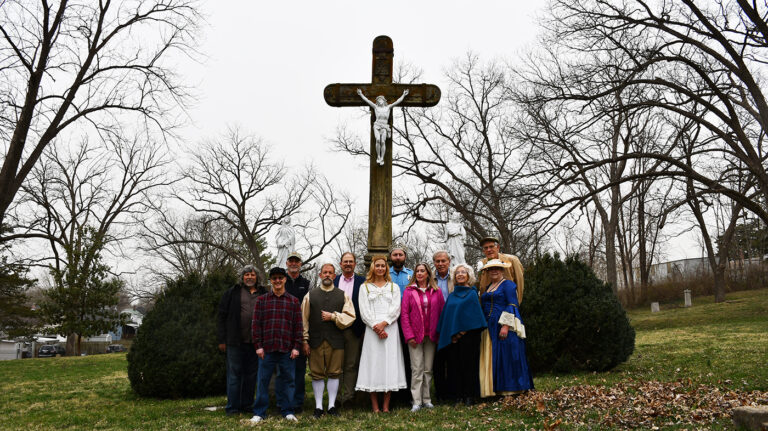


Sainte Genevieve Memorial Cemetery
At 5th and Merchant Streets, where a hillside slopes toward what was once open prairie, Memorial Cemetery holds more than 3,500 known burials and perhaps 1,500 additional unmarked graves—a total approaching 5,000 souls whose wooden crosses rotted away over 235+ years, leaving most graves anonymous. This is not the orderly, manicured cemetery of contemporary imagination but rather something more honest: crowded ground where 235 years of deaths compressed themselves into earth, where French colonists buried in 1787 rest beneath Confederate soldiers buried in 1881, where the absence of markers tells its own profound story about mortality, memory, and what happens when time erases deliberate effort to remember.
A Cemetery That Remembers Through Absence
Established in 1787, Memorial Cemetery was formally blessed in 1791 according to Church records and functions as physical archive of Sainte Genevieve’s entire post-contact history. The oldest existing tombstone belongs to Marie Theres St. Gemme, who died in 1807—though earlier burials certainly occurred between 1787 and 1807, marked then by wooden crosses now long consumed by earth and time. This cemetery contains physical remains of people who lived under French rule, Spanish administration, and American governance—people who witnessed the Louisiana Purchase transform their political identity overnight, who experienced Ste. Genevieve shift from westernmost settlement to ordinary Missouri town.
Three Sections, Three Stories
The middle third—the original Catholic section—served Ste. Genevieve when the town was overwhelmingly French and universally Catholic. As territory diversified following the Louisiana Purchase, an uphill section was added for Protestants, Native Americans, and others. The downhill parcel represented final expansion before the cemetery reached capacity. This physical segregation by religion and space—Catholics occupying the most desirable central location, others relegated to additions—reveals how social hierarchies extended into death itself.
The uphill section contains burials of people who experienced displacement or difference: Protestants whose religions weren’t shared by French Catholic founders, Native Americans many of whom had converted to Catholicism but were still buried separately, and those caught in tragedy like steamboat explosion victims. The cemetery’s willingness to bury diverse populations alongside restrictive segregation demonstrates the complicated reality of frontier settlements where practical necessity sometimes outweighed religious doctrine.
Notable Burials: When Death Held Status
Senator Lewis F. Linn’s burial history remains remarkable—his body was moved to Crestlawn Cemetery in October 1905 when Memo Cemetery had become neglected, then returned in 1937/1938 when the cemetery was restored. When his coffin was opened, observers found his corpse remarkably preserved within its airtight, lead-lined coffin—nearly 95 years after death in 1843, his face recognizable enough that people lined up to view him through a window in the coffin lid.
Odile Pratte Vallé secured burial in the officially closed cemetery by donating land for a new Catholic cemetery and contributing substantially toward a new brick Catholic Church—transforming her burial wish into community infrastructure. John Scott, Missouri’s first U.S. congressman after statehood, rests here alongside Jean Baptiste Vallé, the American commandant who briefly served after the March 10, 1804 transition of Upper Louisiana to American rule (he filled in temporarily for his brother François Vallé, fils, the actual French commandant).
The Unmarked Graves: When Memory Fades to Mounds
Approximately 275 tombstones remain visible today—many unreadable due to weathering, sandstone deterioration, or iron corrosion. The remaining thousands of burials leave only landscape traces: mounds where soil was piled over coffins, depressions where earth settled into the space decomposed coffins left, barely perceptible undulations revealing 235 years of accumulated death.
Why did most graves remain unmarked? Wooden crosses—affordable and available—rotted within 50-100 years. Economic constraints meant most families couldn’t afford stone markers. Cultural practices emphasized burial in consecrated ground more than permanent individual memorialization. Cemetery neglect, which reached crisis by the 1880s when the grounds became “quite weedy and overgrown,” accelerated the loss of even surviving markers when vegetation overgrew them, soil shifted, and recovery became impossible.
The 1881 Closure: When Death Posed Health Hazard
On November 1, 1881, the cemetery officially closed—though post-closure burials did occur: an unidentified man buried by the Odd Fellows (who were subsequently fined $1 each), Odile Pratte Vallé, and Senator Linn’s 1937/1938 reburial. Capacity exhaustion, public health concerns about decomposing bodies and groundwater contamination, the cemetery’s deteriorated condition, and Ste. Genevieve’s growth all conspired to make continued use untenable. Three new cemeteries replaced it: Valle Spring Cemetery for Catholics (named after a spring predating the Vallé family’s ownership), Lutheran Cemetery for the German Protestant population, and Crestlawn Cemetery for others.
Preservation Through Dedication
Since 1995, the Foundation for Restoration of Ste. Genevieve has managed the cemetery, continuing preservation efforts begun in the late 1960s by local historian Lucille Basler. A 2004 Save America’s Treasures grant from the National Park Service funded professional restoration: monument conservation using proper techniques, accessible pathways protecting unmarked graves, and interpretive materials educating visitors about the cemetery’s significance.
The annual Déjà Vu Spirit Reunion—an educational event held near Halloween where community members in period costume stand near graves portraying the historical figures buried beneath them—keeps memory alive through storytelling and interpretation.
The city established the cemetery as a bird sanctuary through Ordinance 1175 in February 1935, recognizing its value beyond burial ground: mature trees and undisturbed character provide habitat for species increasingly rare in developed areas.
Practical Information
- Location: 5th & Merchant Streets, Ste. Genevieve, MO 63670
- Hours: Open daily until dusk
- Admission: Free
- Contact: 573-883-7544
- Maintained By: City of Ste. Genevieve and Foundation for Restoration of Ste. Genevieve
- Website: historicstegen.org
Visit Memorial Cemetery seeking authentic encounter with death as frontier and early American periods experienced it—crowded, stratified by religion and wealth, vulnerable to time’s erosion. Walk among 275 remaining tombstones and thousands of unmarked graves. Consider the lives accumulating in layers across 235 years. Stand where French colonists, Spanish administrators, American pioneers, enslaved people, Native Americans, Civil War soldiers, senators, and ordinary residents remain—most forgotten, all essential to understanding Ste. Genevieve’s complete history. Open daily until dusk. Free. Essential.


Sorry, no records were found. Please adjust your search criteria and try again.
Sorry, unable to load the Maps API.