

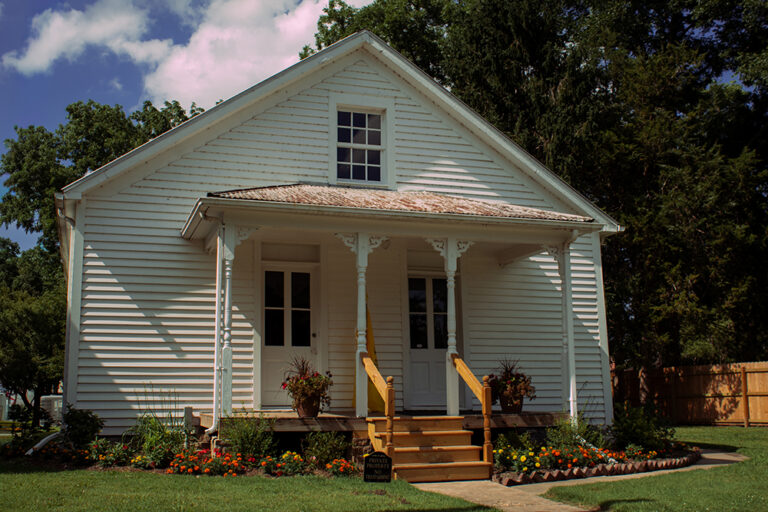
The François Vallé, fils House
Built around 1794 within Ste. Genevieve’s evolving landscape, this house carries the story of a young man who lived through revolutionary transformation—François Vallé, fils, son of colonial merchants, militia officer witnessing the Battle of Fort San Carlos during America’s uncertain birth, resident of a structure that would outlast empires and survive through decades of ordinary family life. Now opened to public interpretation through guided tours, the François Vallé, fils House becomes portal into multiple histories layered within timber and brick: the young officer’s role in Revolutionary-era conflict, the archaeology revealing what earlier centuries deposited within this ground, the Sexauer family’s twentieth-century inhabitation and their quiet determination to preserve what others might have demolished. This is not museum display but rather living interpretation—a tour guide accompanying you across threshold, answering questions as exhibits unfold, honoring both the building’s original significance and the ordinary families who sustained it across generations.
A Young Officer’s Revolutionary Moment
François Vallé, fils inherited more than property from his merchant father. He inherited a family positioned within Ste. Genevieve’s colonial hierarchy, connections threading through French and Spanish governance networks, responsibility for maintaining family prosperity through revolutionary upheaval. When the American Revolution reached the Mississippi Valley in the form of the Battle of Fort San Carlos—that obscure but significant conflict occurring within sight of Ste. Genevieve—young François took up militia responsibility, experiencing combat or at minimum the serious weight of defending colonial settlement against forces seeking to redirect the continent’s political trajectory.
The “Saving St. Louis: Ste. Genevieve and the Battle of Fort San Carlos” exhibit, condensed within this house, contextualizes that moment: upper Louisiana’s delicate position between competing imperial powers, the local militia’s role in preventing Spanish loss of strategic river position, the consequences that rippled forward from this frontier engagement. François Vallé, fils wasn’t battlefield hero but rather ordinary young man conscripted into history’s momentum, his participation in this battle marking him as participant in forces reshaping America itself.
The House Itself: Structure as Witness
Built circa 1794—shortly after the Revolution’s conclusion—this house represents the world François Vallé inherited rather than the revolutionary world his youth inhabited. Yet the building carries evidence of those turbulent times through its very existence, through its position within Ste. Genevieve’s streetscape, through the choices made about its construction during an era when building permanence seemed uncertain.
The exhibits guide visitors through the house’s evolution: how this structure survived, what alterations transformed it across generations, what archaeological evidence reveals about how people actually inhabited these spaces. The building becomes text itself—its materials, its proportions, its relationship to neighboring structures telling stories about colonial values, about shifting architectural fashion, about practical decisions made by ordinary residents.
The Sexauers: Preservation Through Inhabitation
Perhaps most remarkably, this house’s survival depended upon a twentieth-century family’s decision to live within it, to maintain it, to resist the demolition pressure that claimed so many older structures during the mid-twentieth century. The Sexauer family, who lived here in the late 1900s, recognized something worth preserving—either through conscious historical appreciation or simply through the ordinary human attachment that emerges from inhabiting a place long enough that leaving feels unnatural.
Their story becomes part of the exhibit narrative. This isn’t sanitized preservation by professional conservators but rather genuine family stewardship—people choosing to stay, choosing to maintain, choosing to pass forward what they inherited. The Sexauers become partners in history, their twentieth-century choices enabling twenty-first-century visitors to encounter eighteenth-century spaces.
Guided Interpretation: Questions Invited, History Conversational
The tour guide accompanying visitors represents philosophical choice about how history should be experienced. Rather than isolated self-guided exploration, visitors receive human interpretation—expert knowledge combined with genuine conversational response. Questions are invited. Curiosities warrant detailed attention. The guide adapts interpretation to visitor interest rather than following rigid script.
This approach acknowledges something crucial: history lives through engagement, through curious minds encountering objects and spaces and ideas, through questions generating deeper understanding. The tour guide becomes intellectual companion rather than institutional voice.
Practical Information
- Name: The François Vallé, fils House (French Colonial America)
- Location: Ste. Genevieve (accessed through Centre for French Colonial Life)
- Centre Address: 198 Market Street, Ste. Genevieve, Missouri 63670
- Built: Circa 1794
- Original Owner: François Vallé, fils
- Historic Resident Family: The Sexauers (late 20th century, preservation stewards)
- Tour Times: 10:00 AM and 4:00 PM everyday.
- Tour Format: Guided interpretation with tour guide accompaniment
- Ticket Purchase: Centre for French Colonial Life (198 Market Street)
- Phone: 573-883-3105
- Email: roseanne.ahne@frenchcolonialamerica.org
- Group Tours: Available by reservation
- Exhibits: François Vallé, fils biography and role in late 18th century Ste. Genevieve, site archaeology, building evolution, “Saving St. Louis: Ste. Genevieve and the Battle of Fort San Carlos” (condensed version), Sexauer family preservation story
Perfect For:
- History enthusiasts understanding Revolutionary-era frontier conflicts
- Those exploring Ste. Genevieve’s merchant families and colonial hierarchy
- Archaeology and architecture students understanding building preservation
- Visitors interested in how ordinary families sustain historic structures
- Anyone understanding that preservation depends upon inhabitation
- Those seeking guided interpretation over solitary museum browsing
- Groups booking specialized tours
- Visitors following comprehensive French Colonial America campus experience
The François Vallé, fils House succeeds because it refuses separation between “great history” and “ordinary history.” François Vallé, fils participated in Revolutionary-era conflict—historically significant but personally ordinary militia service. The Sexauer family inhabited the house—not historians or preservationists by profession, just people living within a building they recognized as worth maintaining.
The archaeological component matters too. What people left behind—fragments embedded in earth, material evidence of daily life—often tells truer stories than documents or memorials. The archaeology reveals how spaces were actually used, what people valued, how households functioned across centuries.
The guided tour format reflects understanding that history is conversation, not monologue. Visitors arriving with questions, curiosities, personal connections to place deepen their own understanding through dialogue with informed guides. This isn’t passive consumption but rather active engagement.
The Experience
You arrive at the Centre for French Colonial Life, purchase tickets, and a guide accompanies you across threshold toward the François Vallé, fils House. The building greets you with its circa-1794 proportions, its evolved architecture bearing witness to centuries of inhabitation and alteration. The guide introduces François Vallé, fils—young man of his time, militia officer briefly caught in Revolutionary conflict, resident of this house he commissioned.
Within rooms, exhibits provide context: his family’s colonial standing, the Battle of Fort San Carlos’s significance, the archaeological evidence revealing how people actually lived here. The guide answers questions, points out architectural details, shares stories about the Sexauers’ twentieth-century inhabitation and their quiet preservation work.
You encounter history not as distant abstraction but as lived experience—rooms where real people made real lives, where decisions about preservation allowed those lives to remain legible across centuries, where archaeological fragments and architectural evolution tell stories documents might miss.
You leave understanding that preservation emerges through inhabitation, that ordinary families contribute to historical continuity, that buildings carry multiple stories layered across generations, that Revolutionary-era conflicts shaped frontier communities through young men like François Vallé, fils, whose participation in history’s momentum seems almost incidental to the fact of their existence within it.
Visit the François Vallé, fils House seeking guided interpretation of Revolutionary-era Ste. Genevieve. Arrive with questions. Listen to stories about the young officer, the Sexauer family, the building’s evolution. Examine archaeological evidence revealing daily life. Leave understanding that history lives through buildings and through families willing to inhabit and maintain them, that preservation depends upon people choosing to stay rather than seeking elsewhere, that François Vallé, fils’s youthful experience in Revolutionary conflict mattered less ultimately than the fact that his house survived, transformed, inhabited, preserved, finally opened for visitors seeking connection to place and time and the ordinary people who lived within both.
Sorry, no records were found. Please adjust your search criteria and try again.
Sorry, unable to load the Maps API.